The Tragic and Tumultuous Life of Harry Samuel Hay: A Baseball Star Who Never Made It to the Big Leagues
The story of Harry Samuel Hay is one of talent, misfortune, and unfulfilled potential. His journey from a small-town baseball phenom to a struggling minor league pitcher—and eventually to an uncertain post-baseball life—is a narrative pieced together largely from newspaper records, city directories, and census data.
Through these sources, I have reconstructed his career, family life, and ultimate fate, shedding light on the struggles he faced both on and off the field.
Early Life and Family Hardships
Harry Samuel Hay was born on November 24, 1878, in Union Mills, Indiana to James Stark Hay and Luticia Eller Hay. Harry's life was marked by baseball success, controversy, personal struggles, and a tragic end. His journey from small-town independent baseball to near-professional fame provides a fascinating glimpse into early 20th-century baseball and personal hardship.
A Father Who Disappeared
Harry Hay’s early life was shaped by one of the biggest mysteries in his family history. His father, James Stark Hay, abandoned his family around 1892 and started a new life in Michigan, leaving Harry and his siblings without answers. This information, confirmed through documentation and DNA connections, suggests that Harry never knew what became of his father. The loss of a stable paternal figure may have influenced Harry’s struggles with authority, discipline, and personal responsibility throughout his life.
A Rising Star in Independent Baseball
By the early 1900s, Harry Hay had developed into a formidable underhand pitcher, a style that made him a standout in independent and semi-professional baseball. He was frequently compared to Rube Waddell, a famous major league pitcher known for his eccentric behavior and immense talent.
Newspaper reports from 1907-1908 paint a picture of a brilliant but erratic pitcher who could dominate a game but often found himself in controversy or trouble. Some key highlights of his baseball career include:
Rise as a Pitcher: 1905-1908
Harry Hay’s baseball career took off in the mid-1900s when he became known as a formidable underhand pitcher. He played for several teams across Indiana and the Midwest. His ability as a pitcher was frequently praised in newspapers, and he quickly gained a reputation for his unique delivery. However, his temper and struggles with consistency often held him back from progressing further in professional baseball.
Defeating the Cincinnati Reds Twice (1907)

Image created using AI DALL-E tool In two now-legendary games, Harry Hay pitched for the Dunkirk team against the Cincinnati Reds and emerged victorious both times. The first game took place on July 1, 1907, with Dunkirk defeating the Reds 12-7.
In a second matchup later that summer, Hay once again led Dunkirk to victory, this time with a score of 4-2. These wins were so impressive that rumors began circulating that Hay had played for the Reds, though no record exists of him officially joining the team. Newspapers continued to mention him as a former Red, even though it appears he may have had a tryout but never officially made the roster.

Between 1907 and 1908, Hay played for multiple teams, including:
- Auburn (1905)
- Hartford City (1906)
- Dunkirk (1907)
- Van Wert (1907-1908)
- Beardstown (1909-1910)
His talent made him highly sought after, but his temperament and personal struggles often led to quick departures.
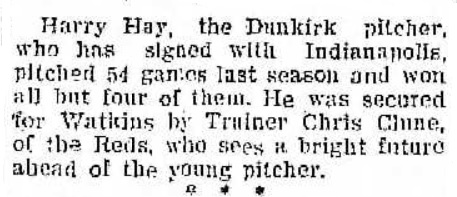
- Reports from Indianapolis newspapers stated that the American Association (a higher-level professional league) had its eyes on Hay, but managers had concerns about his "remarkable natural ability" being offset by his lack of fielding skills and a difficult temperament.
- By 1914, Hay was still pitching in minor leagues. One remarkable game, reported in the Logansport Pharos-Reporter, described him pitching a 21-inning tie game between Kankakee and Streator, one of the longest games ever played in the Illinois-Missouri League.
A Troubled Personal Life
Harry Hay was not just known for his baseball skills—he was also notorious for financial troubles and legal issues.
-
Board Bill Arrests
In June and July 1907, Harry was arrested twice for failing to pay his board bill in different towns. In one case, the team manager had to step in and pay his debt so he could continue traveling with the team. The Decatur Daily Democrat even wrote that Hay had a "habit of overlooking small accounts", implying that this wasn’t an isolated incident.
- Bar Fights and Assaults
In July 1906, after a game in Portland, Indiana, Hay was attacked with a beer bottle outside a restaurant, causing a major team brawl. The attackers were never arrested, and reports suggested that the team had not instigated the fight.
-
 Marriage to Bertha Jones (1907)

On May 28, 1907, Harry married Bertha Jones of Dunkirk. While newspapers praised Hay’s talent on the field, family lore suggests that Bertha’s family disapproved of the match. Ironically, after both Harry and Bertha passed away, her siblings would ultimately take in their children.
-
Struggles with Alcohol
Several reports mention that Hay’s greatest weakness was alcohol, often referred to as "John Barleycorn" in newspapers. One article stated that Hay could be a dominant pitcher—if he could stay sober.
Life After Baseball
After his baseball career faded, Harry Hay's life took a tragic turn. By the 1920s, he was nearly disabled by rheumatism and relied on his wife’s factory job for financial support.
- By 1913, Harry was working as an erector (assembler) for M. Rumely Company, a manufacturer in LaPorte, Indiana. The 1920 census listed his occupation simply as a laborer in a shop. In 1923, city directories recorded him as a general laborer, maybe indicating that he struggled to find stable employment after baseball.
- Bertha Jones Hay passed away on August 12, 1923, due to complications from an injury she sustained at work. Though no official record confirms this, family lore suggests that Harry sued his wife’s employer for damages, a claim supported by a 1924 newspaper report of his lawsuit against the Kumpfy-Kab Company in LaPorte. He won the case and was awarded $3,289 in compensation.
A Tragic End
- Following Bertha’s death in August 1923, Harry’s health rapidly declined. By early 1924, he was almost completely disabled, unable to work, and relied on his mother, Luticia Hay, for care. While family lore suggests he may have suffered from ALS (Lou Gehrig’s disease), his official death certificate lists chronic nephritis (kidney disease) and chronic mitral regurgitation (a heart valve condition) as the causes of death.
- On May 3, 1924, at 10:15 AM, Harry passed away at his mother’s home at 502 Jackson Street, LaPorte, Indiana, at the age of 45 years, 5 months, and 9 days. His mother, Luticia, served as the informant on his Indiana death certificate, confirming his parentage and birthplace.
- Despite his struggles, newspapers across the country continued to refer to him as a former Cincinnati Reds pitcher, demonstrating how deeply the rumors of his playing days had taken root.
Burial and Legacy
- On May 5, 1924, Harry Hay was laid to rest in Union Mills Cemetery, alongside his wife Bertha Jones Hay and their infant daughter Aletha Marie Hay (1917.) His death marked the end of a life filled with baseball triumphs, personal turmoil, and ultimate hardship.
- Though he never officially played for the Reds, his victories over them in 1907 cemented his place in local baseball history, and even in death, his name remained tied to the team
- Obituaries Conflicted on His Baseball Career
- Many newspapers across the country, including The Atlanta Journal, The Sacramento Union, and The Omaha World-Herald, published obituaries claiming Harry Hay was a former major league pitcher.
- These reports were likely based on confusion, as Harry had gained fame by defeating the Reds, not by playing for them.
Final Thoughts
Harry Samuel Hay’s life was one of great talent, missed opportunities, and personal struggles. From his father’s mysterious disappearance to his turbulent baseball career, financial troubles, and tragic end, his story is a compelling reminder of how fame, talent, and hardship can intertwine.
Though he never officially played for the Cincinnati Reds, his legacy in independent baseball and his battles both on and off the field make him an unforgettable figure in early baseball history.
Harry's story is one of perseverance. From dominating local baseball teams to facing personal and financial hardships after the sport, his life was both extraordinary and deeply human. While his baseball dreams may not have led to Major League stardom, the legacy he left behind in local sports history—and in the memories of his family—ensures that his name won’t be forgotten.
Sources
- Multiple newspaper articles (1906-1924) from the Decatur Daily Democrat, Van Wert Bulletin, Indianapolis Star, The Cincinnati Enquirer, Logansport Pharos-Reporter, and others.
- Family documentation and DNA research confirming James Stark Hay's disappearance and Harry’s lack of knowledge about his father’s fate.
- Legal records from the Kumpfy-Kab Company lawsuit (1924).
- Obituaries from newspapers across the U.S., including The Atlanta Journal, The Sacramento Union, and The Omaha World-Herald.